Preliminary Study on the Restoration Modeling of Turquoise Jewelry Unearthed from the No. D107 Tomb (Bamudun Tomb) in Longshan, Anji, Zhejiang Province
-
摘要:
浙江安吉龙山107号古墓(八亩墩)位于浙江省湖州市安吉县递铺街道古城村,属于龙山越国贵族墓葬.该墓葬出土绿松石首饰是吴越时期重要的考古发现,但发掘时大量绿松石呈现散落状态,失去首饰原貌。而同期出土的吴越绿松石首饰可参考的相关资料较少,复原难度较大。基于考古单位所提供的高清测绘模型及文物数据进行推导,利用三维数字化建模技术,从首饰设计及制作原理的角度,对其进行复原建模初探,尽可能精确地展现八亩墩首饰在散落前的形态、制作工艺与装饰细节,为吴越历史文化研究提供直观且可靠的实物参考样本,为三维数字化建模在考古研究中的应用探索可行路径。经复原建模推断,八亩墩出土首饰有绿松石发簪、帽饰、耳饰、链饰、臂饰、腕饰、棺外饰及萤石珠襦。该成果为三维数字化建模在考古复原工作中提供新的思路,为进一步研究八亩墩墓主的身份、地位,乃至吴越地区首饰复原提供参考。
Abstract:The ancient tomb No. D107 (Bamudun Tomb) is located in Gucheng village, Dipu street, Anji county, Huzhou, Zhejiang Province. It belongs to the tomb of aristocrats of Yue State in Longshan. The turquoise cultural relics is an important archaeological discovery during the Wu and Yue Period, but at the time of excavation, the turquoise jewelry had been scattered into turquoise bead groups and lost its original appearance. However, turquoise jewelry from the Wu and Yue Period has less relevant information to refer to and is more difficult to restore. Based on the high-definition surveying and mapping models and cultural relics data provided by archaeological units, along with three-dimensional digital modeling technology, this study conducts a preliminary exploration of the restoration modeling from the perspective of jewelry design and manufacturing principles. It shows the shape, manufacturing process and decorative details of Bamudun jewelry before it was scattered as accurate as possible. This work provides intuitive and reliable physical reference sample for Wu and Yue history and culture, and also explores feasible paths for the application of 3D digital modeling in archaeological research. After research, it is inferred that the restored Bamudun jewelry includes turquoise hairpins, head ornaments, earrings, chain ornaments, arm ornaments, wrist ornaments, exterior coffin ornaments, and fluorite clothing accessories, and is digitally displayed. It provides new insights into the application of 3D digital modeling in archaeological restoration work, and provides reference for further research into the identity and status of the owner of Bamudun Tomb, as well as the jewelry restoration from Wu and Yue area.
-
1. 八亩墩(107号越墓)背景介绍
浙江安吉龙山107号古墓,又名八亩墩(以下均以此简称),属于春秋晚期越国高级贵族墓葬,也是安吉龙山越国贵族墓群中规模最大、等级最高的一座大墓。该古墓现位于浙江省湖州市安吉县递铺街道古城村,是继绍兴印山越王陵发掘之后近20年来,浙江越文化考古的另一项重大发现[1]。八亩墩位于龙山越国贵族墓群的中心位置,由中心主墓、陪葬墓和隍壕三部分构成,是一个完整的贵族墓园。其中,主墓封土呈东西向长方形覆斗状,也是越国王陵的特征之一;两圈陪葬墓围绕主墓四周,最外围隍壕围绕山体一周,将主墓及陪葬墓包围其中[2],体现了墓主人身份较高(图 1)。
![]() 图 1 龙山八亩墩发掘前状貌[3]Figure 1. The pre-excavation state and appearance of Bamudun Tomb, Longshan
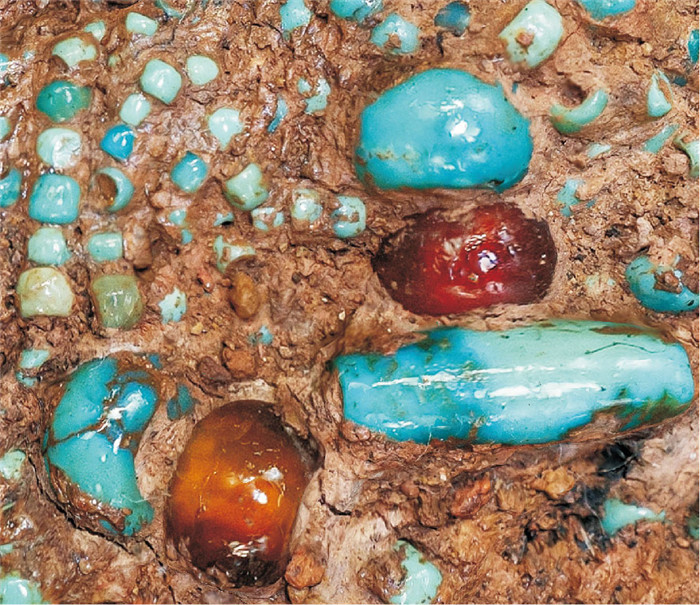
图 1 龙山八亩墩发掘前状貌[3]Figure 1. The pre-excavation state and appearance of Bamudun Tomb, Longshan八亩墩于2011年与2014年两次被盗掘,尤其是2014年,盗墓分子采用炸药爆破手段对该墓葬造成了极大损害[4]。2016年,国家文物局正式批复对八亩墩进行抢救性发掘,幸运地是墓葬关键位置并未受到盗扰,主墓出土文物仍保留原始空间状态。八亩墩的考古发掘持续时间长、规模大、要求高、牵涉面广,目前暂未有详细的发掘报告与资料,据初步统计其主墓出土文物数以千计,有陶、瓷、玉、石等随葬器物大致300余件。其中,绿松石珠千余颗,多数尺寸极小,每颗均有穿孔且表面磨光,展示了当时高超的钻孔与打磨工艺,遗憾的是在发掘时已无法辨认绿松石珠组所构成的首饰全貌,仅能依靠空间位置进行推断其原始状态(图 2)。因此该墓葬出土首饰复原较难,主要原因有:吴越时期首饰具有一定的地域性特征,而八亩墩周边吴越时期墓葬同样也遭受了严重盗掘,缺少同时期同类型文物对比,缺乏相关文献资料。八亩墩是目前唯一在出土时留存有部分较为完好的绿松石珠组位置关系的墓葬,具有较好的复原基础,也可为同时期其他越国墓葬的研究工作提供实物参考依据。
![]() 图 2 龙山八亩墩主墓出土绿松石细节图Figure 2. Details of turquoise unearthed from the main tomb of Bamudun Tomb, Longshan
图 2 龙山八亩墩主墓出土绿松石细节图Figure 2. Details of turquoise unearthed from the main tomb of Bamudun Tomb, Longshan在考古单位发掘八亩墩的过程中,因绿松石珠体积较小、数量庞大,不便提取。为不破坏绿松石珠组原有的位置关系,考古队暂未将其与土体进行剥离,而是将整个含绿松石珠与其他材质玉器的土体进行了高清测绘扫描,确保后续研究。基于上述考古单位的前置工作,本文所研究区域未收到盗扰,且其相关数据信息均来源于考古单位的现有资料,笔者及其团队提出了以出土状态与文物整理数据为基础,结合吴越时代背景,利用三维数字化建模技术对八亩墩首饰造型做进一步推导分析及复原初探,以期复现其首饰原貌,丰富该时期中国首饰文化历程图。
2. 首饰文物数字化建模复原的原则与方法
数字化建模技术因其便利性、低风险、低成本消耗等优势,在文物复原尤其是纺织品、遗迹复原中被广泛运用。它可以实现对文物的非接触式修复,减少因过多接触文物本体而造成的二次损害,同时实现多方案、可逆性的文物复原方法探索,还可将复原文物的数字模型直接应用于数字博物馆文物展示中[5]。
八亩墩出土绿松石珠脱离土体后不便还原,直接将其剥离土体复原的风险较高。基于该类情况,通过高清测绘模型后进行三维数字化建模可以在最低成本及风险情况下对首饰造型进行反复的组合尝试。从发掘状态到重建后的状态都可以通过建模手段完成,甚至可以实现数字化展示和远程共享,极大提高修复工作的科学性、准确性和便利性[6]。例如,耿国华等[7]利用三维建模技术对古人面貌、破损遗迹进行虚拟复原,认为利用数字化手段对文物修复、复原及成果展示宣传具有重大的意义;邓可卉等[8]使用服装CAD软件对袍服残缺部分的款式和结构进行平面复原,使用CLO3D技术进行三维建模,从而实现虚拟复原,并对复原方案进行了动态仿真模拟。因此,在数字化复原建模的框架下,对传统首饰文物的虚拟复原不仅是数字载体上的视觉呈现,更是对文化传承与可持续发展理念的具体实践,具有重要的现实意义。
2.1 数字化首饰文物复原原则
运用现代技术对文物进行修复时,要遵循少干预、零干预的修复原则,确保文物的真实性[9]。文物的外形是其最直观的表现,在数字化建模过程中,要精确测量文物的尺寸、形状等数据信息,尽可能真实还原其外貌特征。通常,考古队利用三维扫描技术对发掘对象进行准确、直观地记录,再现考古发掘现场遗迹、遗物的三维空间分布状态[10]。详细的数据采集可确保后期三维建模过程中能真实地反映文物的原始尺寸、形状、纹理、光泽等特征。
出土文物包括其各个组成部分以及它们之间的连接方式,因此三维数字化复原要尽量保证建模文物的完整性,要确保所有部件都被准确地建模,针对缺失部分或部件,可依据同类文物的形制、历史文化背景以及现存文物的结构规律进行合理的推断与虚拟修复。例如,佟萌等[11]对明代官服结构特点进行细致研究,利用CLO3D技术对朝服、常服、公服套装进行结构复原、面料处理,并在服装虚拟展示软件中进行数字化建模,完成服装的虚拟效果展示。
三维数字化复原还应遵循文物的出土情况及残存状态,从其方位与排布发掘结构细节,以基本保持原来位置的部分器物为基准,以部分轻微散乱的构件位置为辅助,逐步推演出合理的文物建模框架,再填补散乱严重或缺失的文物构件。自始至终逐一地进行分析、判断、组合设计,不可轻下结论,宁缺毋滥,以防造成人为的错乱[12]。
2.2 数字化首饰文物复原流程
数字化复原是以计算机辅助建模为基础,使用数字化设备测量文物尺寸数据并输入计算机后采用虚拟现实、图形技术、三维建模等技术展现文物造型,并对数字模型进行色彩、纹样、材质渲染,复现文物完整的原始形态[13]。八亩墩出土玉石材质与形制均具有典型的吴越时期墓葬首饰特色,多以珠型为主,其形制规整、珠型细小精致、以串饰为主等,其单体件尺寸数据便于建模。但单体件之间并无边缘拼接,因此在复原探索与珠型组合过程中更依赖文物发掘的空间位置关系与首饰设计原理。
依据上述复原原则及相关案例,笔者根据墓葬高清测绘图中的人体结构、文物分布位置和功能对建模首饰区域进行划分,再利用数字化建模技术对人体头部至下部区域首饰依次建模,建模对象主要是绿松石珠组或与其他材质玉器的组合造型;同时,根据发掘出土首饰状况将其分为单体件、单体组合件、复合件三种形态。具体流程:首先对单体文物或零散单体件进行预处理建模;然后对出土位置关系较完好的单体组合件或复合件进行建模;再依照复合件串联规律对单体件进行组合建模;最后完成整体文物的数字化建模,并对其材质进行渲染及3D虚拟佩戴展示[14]。
3. 八亩墩出土首饰的复原建模
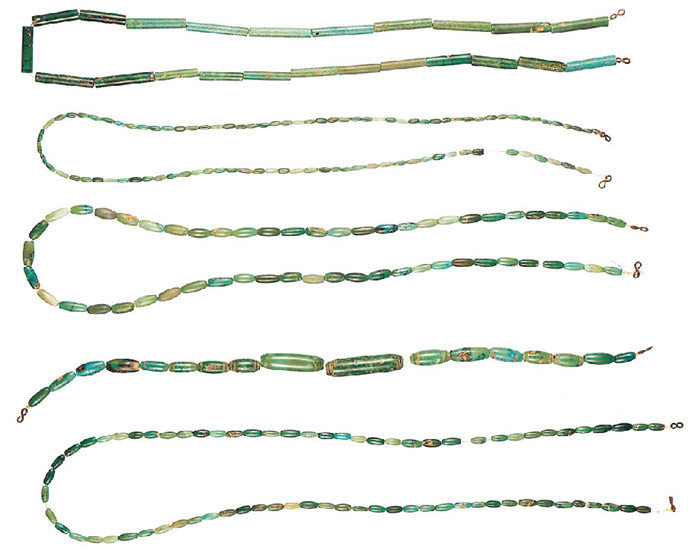
八亩墩出土绿松石珠组与其他材质玉器多以钻孔形式加工,钻孔磨平技术高超,实际考古发掘未发现金属基底,因此考虑出土首饰以织物固定,同样也符合当时的制作技术水平。例如,以苏州博物馆藏春秋时期绿松石串饰为参考(图 3),可以初步了解八亩墩出土绿松石珠组亦为织物串联构成首饰形态。基于本墓葬的特殊情况,笔者选择以建模渲染一体的Nomad软件对八亩墩出土首饰进行复原建模及材质渲染。文本复原建模研究的前置工作如墓葬高清测绘扫描、数据测量等均由考古单位完成,本文所使用的墓葬图片均取自墓葬高清测绘模型。
![]() 图 3 春秋时期出土绿松石串饰(苏州博物馆)Figure 3. Spring and Autumn Period Turquoise ornaments (Suzhou Museum)
图 3 春秋时期出土绿松石串饰(苏州博物馆)Figure 3. Spring and Autumn Period Turquoise ornaments (Suzhou Museum)3.1 建模首饰区域
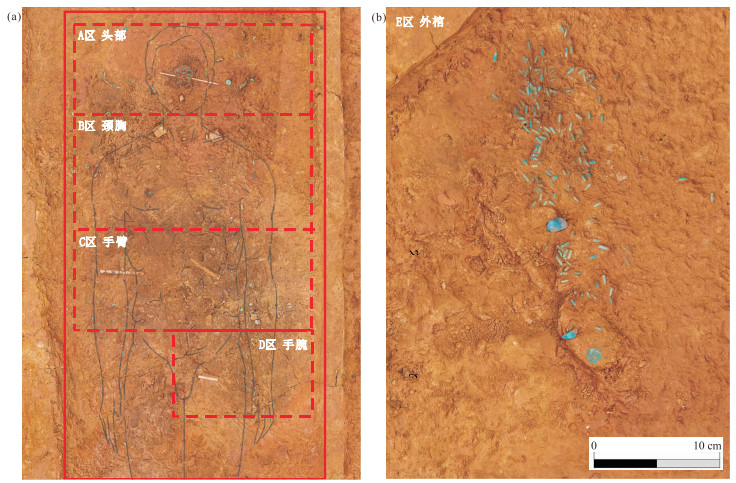
在八亩墩出土文物中,发簪的位置关系保留较为完好,位于人体头部区域。以此为基点,依据人体结构规律及首饰佩戴原则,笔者将散落绿松石珠饰分为四个区域:A区为头部区域,保留关系最为完整,首饰品类最为丰富,基本可以厘清首饰的功能与搭配组合的造型;B区为颈胸区域,主要有颈部首饰,玉石材质丰富且散落较多,可能出现较大位移,空间关系复杂,复原难度最高;C区为手臂区域,D区为手腕区域,分别有臂饰和腕饰,这两个区域可互为参考建模(图 4a);E区为棺外饰区域,保留关系较为完整,首饰品类单一、功能明确(图 4b)。
![]() 图 4 八亩墩出土绿松石首饰分布区域(a)棺内人体分布绿松石首饰区域; (b)棺外绿松石分布尺寸和特征Figure 4. Distribution zoning of turquoise jewelry unearthed from Bamudun Tomb
图 4 八亩墩出土绿松石首饰分布区域(a)棺内人体分布绿松石首饰区域; (b)棺外绿松石分布尺寸和特征Figure 4. Distribution zoning of turquoise jewelry unearthed from Bamudun Tomb3.2 头部首饰复原建模
为方便分件重建,将A区依照散落情况及空间关系又划分为5个部分,即G1发簪、G2左耳饰、G3右耳饰、G4头饰和G5口晗部分(图 5,黑区为取样留图)。G1发簪基本处于原位,没有发生相对位移。复原建模初期有顶发髻与后发髻两种造型推测,但该发簪整体造型保留较为完好且不同珠型分布较为清晰,参考浙江绍兴漓渚出土鸠杖杖镦跽坐人像(图 6)的后发髻造型,初步判断该首饰同为后髻发簪;G2、G3部分有较为对称的长条形坠饰,且发簪两端无孔,故这两个部分排除发簪坠饰,考虑为耳饰;G4部分有散落的绿松石单体件,G5因玉石材质不同以及位置特殊,推测为祭祀口晗。
![]() 图 6 浙江绍兴漓渚出土鸠杖杖镦跽坐人像(柯桥区博物馆)Figure 6. portrait sitting man with a dove stick unearthed in Lizhu, Shaoxing, Zhejiang (Keqiao District Museum)
图 6 浙江绍兴漓渚出土鸠杖杖镦跽坐人像(柯桥区博物馆)Figure 6. portrait sitting man with a dove stick unearthed in Lizhu, Shaoxing, Zhejiang (Keqiao District Museum)3.2.1 发簪复原建模
G1发簪中的组成珠型、尺寸、数量统计如表 1所示。依据其出土情况,发簪中心分布有绿松石大珠管与玛瑙珠、绿松石管珠组合,该复合件的尺寸远大于周边碎珠,故推测其为发簪的视觉中心点。其余绿松石小碎珠集中分布在右下方,珠与珠之间的部分小孔仍排列整齐,碎珠之间串联关系明确,呈流苏状排列(图 7a)。复原建模后,发簪的主体玉珠宽度2.7 cm, 长度4 cm,与散落后的尺寸范围相吻合(图 7b)。
表 1 G1发簪珠型、尺寸及数量统计结果Table 1. Type, size and quantity statistics of G1 hairpin长玉簪 玛瑙珠 大珠管 小珠管 大管珠 小管珠 小碎珠 数量 1个 2个 2个 20个 2个 40个 140个 尺寸 外径0.5 cm,厚度15.3 cm,无孔道,两端平抛 外径0.6 cm,厚度0.4 cm,内孔0.3 cm,孔口平抛,与对孔大管珠等大等厚 外径0.4 cm,长度1.0~1.2 cm,内孔0.2 cm,孔口平抛 外径0.3 cm,长度0.7 cm,内孔1.5 cm, 孔口平抛 外径0.6 cm,厚度0.4 cm,内孔0.3 cm,孔口平抛 外径0.3 cm,厚度0.2 cm,内孔0.1 cm,孔口平抛 外径0.2 cm,厚度0.1 cm,内孔0.1 cm,孔口平抛 ![]() 图 7 G1发簪出土情况(a)及复原建模图(b)Figure 7. Unearthed condition (a) of G1 hairpins and its restoration modeling photo (b)
图 7 G1发簪出土情况(a)及复原建模图(b)Figure 7. Unearthed condition (a) of G1 hairpins and its restoration modeling photo (b)3.2.2 耳饰复原建模
G2和G3耳饰珠型较为丰富,有大管珠、中圆珠、小管珠与小碎珠(表 2)。因G2右耳饰保存更为完好,可以判断出耳饰的主体构成应为大管珠与小管珠的穿插组合,以小碎珠为辅助装饰。耳饰底部还悬挂有坠饰,坠饰以小管珠为主体,与小碎珠穿插排列(图 8a),依此规律进行数字化复原建模(图 8b)。在建模过程中,还需注意出土耳饰的工艺要求,如要达到出土时珠串排列整齐且无堆积现象,那么主体绳需要有一定的粗度及硬度,而未散落小碎珠单独串绳并参与主体绳串联,这样符合耳饰顶部向外散落的出土状态。
表 2 G2单边耳饰珠型、尺寸及数量的统计结果Table 2. Type, size and quantity statistics of G2 one-sided earring珠型 大珠管 中圆珠 小管珠 小碎珠 数量 3个 8个 8个 80个 尺寸 外径0.5 cm, 长度1.1 cm, 内孔0.25 cm, 孔口平抛 外径0.4 cm, 厚度0.3 cm, 内孔0.2 cm, 孔口平抛 外径0.3 cm, 厚度0.2 cm, 内孔0.1 cm, 孔口平抛 外径0.15 cm, 厚度0.15 cm, 内孔0.1 cm, 孔口平抛 ![]() 图 8 G2右耳饰与G3左耳饰出土情况(a)及复原建模图(b)注:图 8a中红线为左右结构一一对应标识,黑区为绿松石取样留图,原位为箭头处Figure 8. Unearthed condition (a) of G2 right earrings and G3 left earrings and their restoration modeling photo (b)
图 8 G2右耳饰与G3左耳饰出土情况(a)及复原建模图(b)注:图 8a中红线为左右结构一一对应标识,黑区为绿松石取样留图,原位为箭头处Figure 8. Unearthed condition (a) of G2 right earrings and G3 left earrings and their restoration modeling photo (b)3.2.3 冠饰复原建模
发簪及左右耳饰复原建模后,头部G4区域留下个别相对孤零的部件,分别为绿松石圆片1件、小管珠3件及小碎珠5件。其中,绿松石圆片的正面及边缘无孔;3件小管珠尺寸相似,有2件上下均配有1件绿松石小碎珠,且与其他首饰没有串连痕迹。绿松石圆片的直径和珠管的长度均为13~14 mm,据此这些单件体可能来自于冠饰,并以织物固定于一个宽14 mm的冠饰帽檐上,作为装饰用途(图 9)。
3.3 颈胸部首饰复原建模
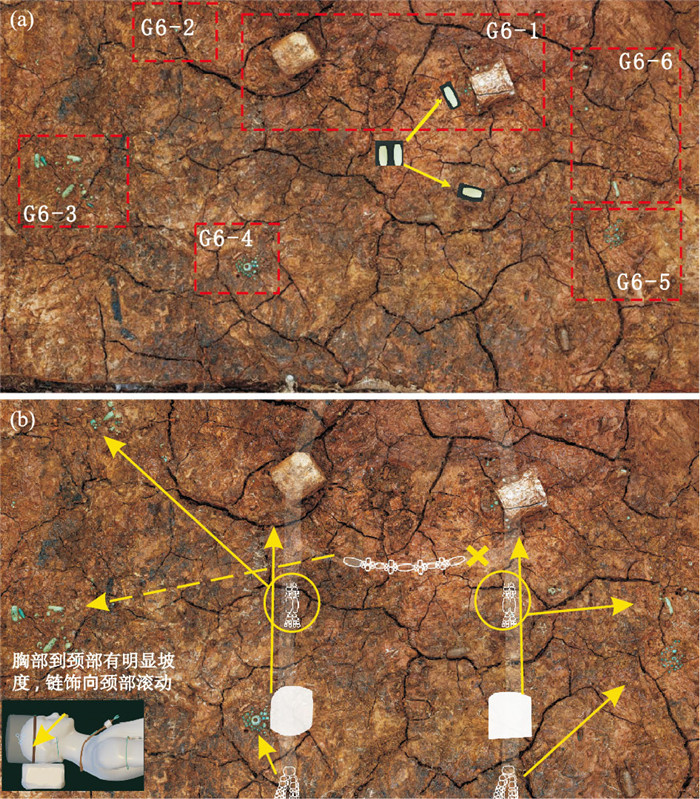
B区颈胸部出土首饰材质主要有绿松石、和田玉等,形制较为丰富,初步判断为颈部链饰。由于该区域绿松石分散分布,笔者将其分为6个部分(G6-1~G-6, 见图 10a),并逐一复原建模。其中,G6-1中2个玉坠分别位于人体颈部两侧,位置与形制相对一致。由于玉坠体积过大,较少出现于颈部处,笔者推测可能来自其他部位;G6-4与G6-5处的绿松石件以颈胸中轴呈不完全对称分布,G6-6与G6-2处的绿松石也同样呈不完全对称分布,G6-3处的绿松石呈散落、长条状,这几处可能均有不同程度的位移。
![]() 图 10 B区颈胸部首饰的出土情况(a)及其链饰位移路径(b)Figure 10. Unearthed condition (a) of neck and chest from area B (a) and its chain displacement path (b)
图 10 B区颈胸部首饰的出土情况(a)及其链饰位移路径(b)Figure 10. Unearthed condition (a) of neck and chest from area B (a) and its chain displacement path (b)颈部链饰产生较大位移的主要原因或与和田玉管珠重量有关,当人体或土体腐烂塌陷后,玉坠连带绿松石一起发生位置改变。从图 10b可以看出,人体胸腔到颈部呈高坡走势,胸部玉柱管滚落至颈部双侧,连带两边装饰一起向身体两侧散落,白色线框可能为原始位置,黄色箭头为滚落方向。依此推理,还原颈部链饰位移前的状态, 再结合出土形态逐一组合,完成该首饰的复原建模(图 11)。
3.4 臂部首饰复原建模
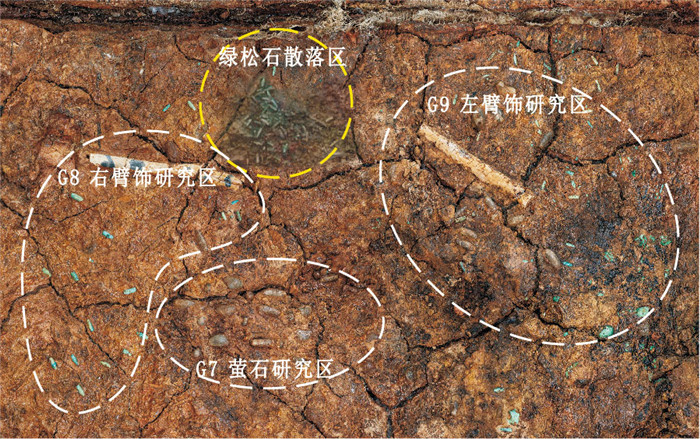
从出土分布位置来看,位于躯干两侧的臂部分布有小尺寸的绿松石及和田玉管珠,另有57粒萤石管珠集中于躯干处,考虑为胸饰残存。为了方便分件建模,依据材质及散落位置,将C区臂部首饰划分了3个部分,即G7、G8和G9(图 12)。G7规律分布萤石管珠;G8和G9分布材料相同、形制相似且造型较对称的绿松石及和田玉管珠组合,推测为左右臂饰[15]。图 12中的黄线区堆积有散落的绿松石珠组。在古代用玉制度中,绿松石等制较高,萤石一般作为隔珠使用,但G7萤石的尺寸较大,可初步排除其隔珠作用。局部出土萤石排列秩序完好,推测其应是单独组成珠襦,用于祭祀,与该时期的厚葬风俗相吻合。根据难易程度,复原建模优先厘清珠襦部分首饰。
3.4.1 珠襦复原建模
G7局部萤石由三种不同形状的珠型呈4组规律组成(表 3),建模过程按照该规律补齐剩余萤石单件,复原后的珠襦长度约为32 cm,覆盖于人体胸部(图 13)。
表 3 G7珠襦珠型、尺寸及数量的统计结果Table 3. Type, size and quantity statistics of G7 clothing accessories珠型 珠管 角管 管珠 数量 18个 12个 27个 尺寸 外径0.6 cm, 厚度1.5 cm, 内孔0.2 cm, 孔口平抛 外径0.7 cm, 厚度1.4 cm, 内孔0.2 cm, 孔口平抛 外径0.6 cm, 厚度0.6 cm, 内孔0.2 cm, 孔口平抛 ![]() 图 13 G7珠襦的出土情况(a)及复原建模图(b)Figure 13. Unearthed condition (a) of clothing accessories and its restoration modeling photo (b)
图 13 G7珠襦的出土情况(a)及复原建模图(b)Figure 13. Unearthed condition (a) of clothing accessories and its restoration modeling photo (b)3.4.2 臂饰复原建模
浙江东阳前山越墓出土随葬品中的长管状玉石侧边有两孔与本文研究的八亩墩越墓长管状玉石相似度极高(图 14),但暂无功能说明[16]。C区G8和G9长管状玉石与珠串区域位置接近,考虑为左右臂饰的一部分,由1个玉管、70粒绿松石小珠管及80粒绿松石小碎珠组成。其中,50粒小珠管组成臂环,其由和田玉管衔接20粒小珠管与80粒小碎珠用作坠饰,复原建模后该臂饰直径约为12.7 cm,坠饰分别长14.0 cm与16.8 cm(图 15)。
![]() 图 14 浙江东阳前山越墓出土随葬品中的长管状玉石Figure 14. Long tubular jade artifact unearthed from Yue tomb at Dongyang, Qianshan, Zhejiang Province
图 14 浙江东阳前山越墓出土随葬品中的长管状玉石Figure 14. Long tubular jade artifact unearthed from Yue tomb at Dongyang, Qianshan, Zhejiang Province3.5 腕部首饰复原建模
D区腕部首饰的构成部件与C区臂饰的相似度较高,参考西周晚期至春秋早期出土的碎珠串连玉腕饰(图 16)以及佩戴首饰的套系特点,推断D区腕部首饰应为腕饰且其造型与臂饰相搭配。D区腕饰构成部件如表 4所示,25粒绿松石小珠管组成腕环,围度为17.5 cm,玉管坠于绿松石腕环上,绿松石小碎珠佩于玉管下端,复原建模如图 17所示(图 17a黑区为绿松石管珠取样留图)。
![]() 图 16 西周晚期至春秋早期玉腕饰(陕西考古研究院)Figure 16. Jade wrist ornaments from the late Western Zhou Dynasty to the early Spring and Autumn Period (Shaanxi Institute of Archaeology)表 4 D区腕饰珠型、尺寸及数量的统计结果Table 4. Type, size and quantity statistics of wrist ornaments from area D
图 16 西周晚期至春秋早期玉腕饰(陕西考古研究院)Figure 16. Jade wrist ornaments from the late Western Zhou Dynasty to the early Spring and Autumn Period (Shaanxi Institute of Archaeology)表 4 D区腕饰珠型、尺寸及数量的统计结果Table 4. Type, size and quantity statistics of wrist ornaments from area D珠型 长玉管 小管珠 小碎珠 数量 1个 25个 8个 尺寸 外径0.7 cm, 长度5.0 cm, 内孔0.5 cm, 孔口平抛 外径0.3 cm, 厚度0.7 cm, 内孔0.1 cm, 孔口平抛 外径0.2 cm, 厚度0.2 cm, 内孔0.1 cm, 孔口平抛 ![]() 图 17 D区腕饰的出土情况(a)及复原建模图(b)Figure 17. Unearthed condition (a) of wrist restoration and its restoration modeling photo (b)
图 17 D区腕饰的出土情况(a)及复原建模图(b)Figure 17. Unearthed condition (a) of wrist restoration and its restoration modeling photo (b)3.6 棺外饰复原建模
棺外区仅有一件首饰,主要部件:2个绿松石圆片(其中1个切成2个半圆),128粒绿松石小珠管,86粒绿松石小碎珠,其复原建模参考了西周单佩联珠组合玉项饰(图 18[17])。从出土情况来看,这件首饰保留有较完好的排列关系,小碎珠与小珠管在整条链饰上下两端呈穿插排列,两个半圆扣断面整齐,从图 19a黑区取样处可看出半圆扣断面平滑光亮,推断人为切割作为链饰对扣装饰。复原建模后,E区棺外链饰的上部分为80粒珠管与45粒碎珠组成,下部分为48粒珠管与35粒珠管组成(图 19b)。
![]() 图 18 西周单佩联珠组合玉项饰[17]Figure 18. Western Zhou Dynasty jade necklace featuring single pendant and linked beads
图 18 西周单佩联珠组合玉项饰[17]Figure 18. Western Zhou Dynasty jade necklace featuring single pendant and linked beads![]() 图 19 棺外链饰的出土情况(a)及复原建模图(b)Figure 19. Unearthed condition (a) of the external chain ornament adorning the coffin and its restoration modeling photo (b)
图 19 棺外链饰的出土情况(a)及复原建模图(b)Figure 19. Unearthed condition (a) of the external chain ornament adorning the coffin and its restoration modeling photo (b)总之,八亩墩首饰复原建模的难点在于出土单体组合件较多,多数部件已发生不同程度的位移,以及碎珠不便清出,再加上同时期可参考资料严重匮乏,导致其原貌难以辨认。本次复原建模过程主要凭借八亩墩首饰的考古发掘信息,对出土首饰区域进行拆解分析,并对位移前后状态反复模拟从而获得首饰全貌(图 20)[18]。
![]() 图 20 八亩墩首饰的复原建模图(a)白色为复原后首饰造型; (b)Nomad人体试戴建模效果(左图为入葬模拟图;右图为人体佩戴模拟图)Figure 20. The restoration modeling photos of the jewelry unearthed from Bamudan Tomb
图 20 八亩墩首饰的复原建模图(a)白色为复原后首饰造型; (b)Nomad人体试戴建模效果(左图为入葬模拟图;右图为人体佩戴模拟图)Figure 20. The restoration modeling photos of the jewelry unearthed from Bamudan Tomb4. 结语
传统的接触式测量和修复方法可能会对出土情况较为复杂的文物造成不可逆转的二次伤害。三维数字化复原技术如3D扫描、高清测绘等非接触式测量,可以在不触碰文物的情况下,精确地获取相关数字信息,并完成其数字化建模与复原模拟。本文八亩墩出土绿松石或和田玉首饰的造型复杂、构件零散,采用数字化建模技术能有效避免因物理接触而引起首饰部件位移,更好地实现其无损数据记录与复原建模。修复人员可以在数字化虚拟环境下对文物的不同修复方案进行预演,还通过3D打印制作仿制品进行实物复原预演,与出土文物进行详细对比,筛选出最优的修复复原方案,减少实际修复过程中的试错成本,降低文物伤害的潜在风险。
基于考古单位的高精度扫描模型与数据测量等前置工作,遵循首饰设计及制作的基本原则,利用数字化建模技术对八亩墩出土绿松石珠组及其他材质玉器所组构的首饰功能及造型进行复原推演及虚拟复现文物原貌,该墓葬首饰种类有绿松石发簪、帽饰、耳饰、链饰、臂饰、腕饰、棺外饰及萤石珠襦,其3D模型已于浙江省安吉古城国家考古遗址公园进行展览。随着互联网和数字技术的发展,数字化模型可以更加便捷地展示于网络平台、数字博物馆等虚拟环境。这种展示方式突破了时间和空间的限制,笔者在项目过程中也以此方案与考古单位进行反复的汇报与修正。
本次文物的复原建模方案探索初步解决了八亩墩同时期出土首饰样本对照单一的问题,对研究数字化考古工作以及进一步研究八亩墩首饰原貌具有一定的参考价值,对弥补文献记载较少的吴越时期历史,反应当时的社会生产发展力水平、艺术水平、科学成就及社会文化内涵等都具有一定的推进作用。
致谢: 本文得到国家社科基金项目“产源视角下浙江安吉龙山107号墓(八亩墩)出土绿松石研究”(项目编号:20BKG030)支持,感谢浙江省文物考古研究所及安吉八亩墩发掘项目团队提供高清测绘扫描模型、文物数据信息及相关支持,谨致谢忱! -
![]()
图 1 龙山八亩墩发掘前状貌[3]
Figure 1. The pre-excavation state and appearance of Bamudun Tomb, Longshan
![]()
图 2 龙山八亩墩主墓出土绿松石细节图
Figure 2. Details of turquoise unearthed from the main tomb of Bamudun Tomb, Longshan
![]()
图 3 春秋时期出土绿松石串饰(苏州博物馆)
Figure 3. Spring and Autumn Period Turquoise ornaments (Suzhou Museum)
![]()
图 4 八亩墩出土绿松石首饰分布区域
(a)棺内人体分布绿松石首饰区域; (b)棺外绿松石分布尺寸和特征
Figure 4. Distribution zoning of turquoise jewelry unearthed from Bamudun Tomb
![]()
图 6 浙江绍兴漓渚出土鸠杖杖镦跽坐人像(柯桥区博物馆)
Figure 6. portrait sitting man with a dove stick unearthed in Lizhu, Shaoxing, Zhejiang (Keqiao District Museum)
![]()
图 7 G1发簪出土情况(a)及复原建模图(b)
Figure 7. Unearthed condition (a) of G1 hairpins and its restoration modeling photo (b)
![]()
图 8 G2右耳饰与G3左耳饰出土情况(a)及复原建模图(b)
注:图 8a中红线为左右结构一一对应标识,黑区为绿松石取样留图,原位为箭头处
Figure 8. Unearthed condition (a) of G2 right earrings and G3 left earrings and their restoration modeling photo (b)
![]()
图 10 B区颈胸部首饰的出土情况(a)及其链饰位移路径(b)
Figure 10. Unearthed condition (a) of neck and chest from area B (a) and its chain displacement path (b)
![]()
图 13 G7珠襦的出土情况(a)及复原建模图(b)
Figure 13. Unearthed condition (a) of clothing accessories and its restoration modeling photo (b)
![]()
图 14 浙江东阳前山越墓出土随葬品中的长管状玉石
Figure 14. Long tubular jade artifact unearthed from Yue tomb at Dongyang, Qianshan, Zhejiang Province
![]()
图 16 西周晚期至春秋早期玉腕饰(陕西考古研究院)
Figure 16. Jade wrist ornaments from the late Western Zhou Dynasty to the early Spring and Autumn Period (Shaanxi Institute of Archaeology)
![]()
图 17 D区腕饰的出土情况(a)及复原建模图(b)
Figure 17. Unearthed condition (a) of wrist restoration and its restoration modeling photo (b)
![]()
图 18 西周单佩联珠组合玉项饰[17]
Figure 18. Western Zhou Dynasty jade necklace featuring single pendant and linked beads
![]()
图 19 棺外链饰的出土情况(a)及复原建模图(b)
Figure 19. Unearthed condition (a) of the external chain ornament adorning the coffin and its restoration modeling photo (b)
![]()
图 20 八亩墩首饰的复原建模图
(a)白色为复原后首饰造型; (b)Nomad人体试戴建模效果(左图为入葬模拟图;右图为人体佩戴模拟图)
Figure 20. The restoration modeling photos of the jewelry unearthed from Bamudan Tomb
表 1 G1发簪珠型、尺寸及数量统计结果
Table 1 Type, size and quantity statistics of G1 hairpin
长玉簪 玛瑙珠 大珠管 小珠管 大管珠 小管珠 小碎珠 数量 1个 2个 2个 20个 2个 40个 140个 尺寸 外径0.5 cm,厚度15.3 cm,无孔道,两端平抛 外径0.6 cm,厚度0.4 cm,内孔0.3 cm,孔口平抛,与对孔大管珠等大等厚 外径0.4 cm,长度1.0~1.2 cm,内孔0.2 cm,孔口平抛 外径0.3 cm,长度0.7 cm,内孔1.5 cm, 孔口平抛 外径0.6 cm,厚度0.4 cm,内孔0.3 cm,孔口平抛 外径0.3 cm,厚度0.2 cm,内孔0.1 cm,孔口平抛 外径0.2 cm,厚度0.1 cm,内孔0.1 cm,孔口平抛  下载: 导出CSV
表 2 G2单边耳饰珠型、尺寸及数量的统计结果
Table 2 Type, size and quantity statistics of G2 one-sided earring
珠型 大珠管 中圆珠 小管珠 小碎珠 数量 3个 8个 8个 80个 尺寸 外径0.5 cm, 长度1.1 cm, 内孔0.25 cm, 孔口平抛 外径0.4 cm, 厚度0.3 cm, 内孔0.2 cm, 孔口平抛 外径0.3 cm, 厚度0.2 cm, 内孔0.1 cm, 孔口平抛 外径0.15 cm, 厚度0.15 cm, 内孔0.1 cm, 孔口平抛
下载: 导出CSV
表 3 G7珠襦珠型、尺寸及数量的统计结果
Table 3 Type, size and quantity statistics of G7 clothing accessories
珠型 珠管 角管 管珠 数量 18个 12个 27个 尺寸 外径0.6 cm, 厚度1.5 cm, 内孔0.2 cm, 孔口平抛 外径0.7 cm, 厚度1.4 cm, 内孔0.2 cm, 孔口平抛 外径0.6 cm, 厚度0.6 cm, 内孔0.2 cm, 孔口平抛
下载: 导出CSV
表 4 D区腕饰珠型、尺寸及数量的统计结果
Table 4 Type, size and quantity statistics of wrist ornaments from area D
珠型 长玉管 小管珠 小碎珠 数量 1个 25个 8个 尺寸 外径0.7 cm, 长度5.0 cm, 内孔0.5 cm, 孔口平抛 外径0.3 cm, 厚度0.7 cm, 内孔0.1 cm, 孔口平抛 外径0.2 cm, 厚度0.2 cm, 内孔0.1 cm, 孔口平抛
下载: 导出CSV
-
[1] 姜炎, 杨明星, 田正标, 等. 基于矿源视角下浙江安吉龙山越国107号墓(八亩墩大墓)绿松石组饰研究[J]. 宝石和宝石学杂志(中英文), 2024, 26(5): 76-90. Jiang Y, Yang M X, Tian Z B. A study on the turquoise burial ornaments of D107(Bamudun tomb)from Longshan Yue State, Anji, Zhejiang Province, based on the geographic origin tracing[J]. Journal of Gems & Gemmology, 2024, 26(5): 76-90. (in Chinese)
[2] 张闻捷, 陈沁菲. 安吉八亩墩越墓用鼎制度初考——兼论春秋晚期楚越礼制文化交流[J]. 江汉考古, 2022(5): 88-96. Zhang W J, Chen Q F. A preliminary study on the ding system used in the Yue Tomb at Bamudun, Anji——Concurrently discussing the cultural exchange of etiquette between Chu and Yue in the late Spring and Autumn Period[J]. Jianghan archaeology, 2022(5): 88-96. (in Chinese)
[3] 安吉新闻网. 龙山107号墓(八亩墩)考古发掘成果首次公布[EB/OL]. [2019-11-01]. https://www.meilianji.cn/ajnews/news.html?news_id=31223. Anji news. The archaeological excavation results of Longshan Tomb D107 (Bamudun) were announced for the first time [EB/OL]. [2019-11-01]. https://www.meilianji.cn/ajnews/news.html?news_id=31223. (in Chinese)
[4] 陈玉兰. 浙江安吉龙山八亩墩考古发掘正式获批. [EB/OL]. [2016-07-25]. http://kaogu.cssn.cn/zwb/xccz/201607/t20160725_3938172.shtml. Chen Y L. Archaeological excavation of Bamudun in Longshan, Anji, Zhejiang Province was officially approved[EB/OL]. [2016-07-25]. http://kaogu.cssn.cn/zwb/xccz/201607/t20160725_3938172.shtml. (in Chinese)
[5] 邓可卉, 卫艺林. 基于三维服装建模技术的古代服装数字化虚拟复原[J]. 纺织学报, 2023, 44(4): 179-186. Deng K H, Wei Y L. Digital virtual restoration of ancient clothing based on 3D clothing modeling technology[J]. Journal of Textile Research, 2023, 44(4): 179-186. (in Chinese)
[6] 李幸刚, 孙琼琼. 瓷器三维建模技术在文物修复中的应用研究[J]. 丝网印刷, 2024(19): 113-115. Li X G, Sun Q Q. Application of porcelain three-dimensional modeling technology in cultural relic restoration[J]. Screen Printing, 2024(19): 113-115. (in Chinese)
[7] 耿国华, 冯龙, 李康, 等. 秦陵文物数字化及虚拟复原研究综述[J]. 西北大学学报(自然科学版), 2021, 51(5): 710-721. Geng G H, Feng L, Li K, et al. A review of research on digitization and virtual restoration of Qin Mausoleum cultural relics[J]. Journal of Northwest University(Natural Science Edition), 2021, 51(5): 710-721. (in Chinese)
[8] 邓可卉, 卫艺林. 基于三维服装建模技术的古代服装数字化虚拟复原[J]. 纺织学报, 2023, 44(4): 179-186. Deng K H, Wei Y L. Digital virtual restoration of ancient clothing based on 3D clothing modeling technology[J]. Journal of Textile Research, 2023, 44(4): 179-186. (in Chinese)
[9] 唐泽华. 基于文物保护与修复相关问题的分析[J]. 文物鉴定与鉴赏, 2020(15): 102-103. doi: 10.3969/j.issn.1674-8697.2020.15.043 Tang Z H. Analysis of issues related to cultural relics protection and restoration[J]. Identification and Appreciation to Cultural Relics, 2020(15): 102-103. (in Chinese) doi: 10.3969/j.issn.1674-8697.2020.15.043
[10] 南竣祥, 李季真, 周磊, 等. 考古发掘及出土文物的数字化技术与应用[J]. 测绘标准化, 2022, 38(1): 83-87. Nan J X, Li J Z, Zhou L, et al. Digital technology and application of archaeological excavation and unearthed cultural relics[J]. Standardization of Surveying and Mapping, 2022, 38(1): 83-87. (in Chinese)
[11] 佟萌, 李雪飞. 明代官服的结构研究与数字化复原[J]. 丝绸, 2021, 58(12): 110-116. doi: 10.3969/j.issn.1001-7003.2021.12.018 Li M, Li X F. Structural research and digital restoration of official clothing in the Ming Dynasty[J]. Journal of Silk, 2021, 58(12): 110-116. (in Chinese) doi: 10.3969/j.issn.1001-7003.2021.12.018
[12] 孙治国. 文物保护与修复工作创新发展[J]. 中国民族博览, 2021(8): 194-196. doi: 10.3969/j.issn.1007-4198.2021.08.058 Sun Z G. Innovative development of cultural relics protection and restoration[J]. China National Exhibition, 2021(8): 194-196. (in Chinese) doi: 10.3969/j.issn.1007-4198.2021.08.058
[13] 姜宽舒, 于泓, 宋元山, 等. 基于三维扫描及3D打印的文物数字化保存与逆向修复技术研究与应用[J]. 科学技术创新, 2024(2): 17-23. Jiang K S, Yu H, Song Y S, et al. Research and application of digital preservation and reverse restoration of cultural relics based on 3D scanning and 3D printing[J]. Scientific and Technological Innovation, 2024(2): 17-23. (in Chinese)
[14] 潘鹏. 3D技术加持下的数字文物体验馆前瞻[J]. 文物鉴定与鉴赏, 2022(6): 141-143. Pan P. Prospects for the digital cultural relics experience hall with the help of 3D technology[J]. Identification and Appreciation to Cultural Relics, 2022(6): 141-143. (in Chinese)
[15] 袁胜文. "鳞施"与"珠襦"考[J]. 中原文物, 2017(1): 59-65. Yuan S W. A study on "Linshi" and "Zhuru"[J]. Cultural Relics of Central China, 2017(1): 59-65. (in Chinese)
[16] 浙江省文物考古研究所. 浙江越墓[M]. 北京: 科学出版社, 2009: 10-29. Zhejiang Provincial Institute of Cultural Relics and Archaeology. Tomb of the State of Yue in Zhejiang Province[M]. Beijing: Science and Technology Publishing, 2009: 10-29. (in Chinese)
[17] 盘龙城遗址博物院. 色如天相 器传千秋: 中国绿松石文化展[M]. 北京: 科学出版社, 2022: 9. Panlongcheng Site Museum. Mirrored like sky, inherited by generations: The exhibition of turquoise culture of ancient China[M]. Beijing: Science and Technology Publishing. 2022: 9. (in Chinese)
[18] 徐良高. 考古学文化、文献文本与吴越早期历史的构建[J]. 考古, 2020(9): 81-92. Xu L G. Archaeological culture, documentary texts and the construction of early history of Wuyue region[J]. Archaeology, 2020(9): 81-92. (in Chinese)





计量
- 文章访问数: 36
- HTML全文浏览量: 10
- PDF下载量: 22